

What is a bunion ?
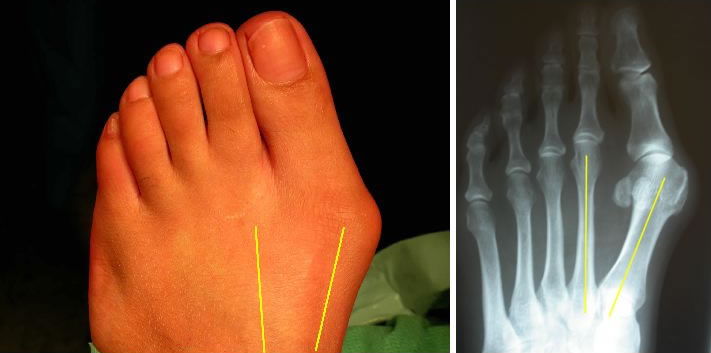
A bunion (or hallux valgus) is a prominence on the inner border of the foot effecting the big toe and at the level of the 1st metatarso-phalangeal (MTP) joint. The bunion is not due to any growth of bone but is due to the 1st metatarsal head sitting in a prominent position . This occurs because because the 1st metatarsal has moved away from its immediate neighbour the 2nd metatarsal into a more medial position. This splaying as shown in the above X-ray & clinical photo widens the forefoot thus producing the bunion.
What causes the splaying is open to debate but one effect is that the tendons above and beneath the joint are no longer centralised over the joint , but sit to the lateral side of the joint. This means that rather than stabilising the joint by their midline position they exert an off-centre pull on the big toe itself which then adopts a typical laterally deviated position.
Corrective surgery for hallux valgus involves surgically moving the 1st metatarsal back to its previous position (by dividing the bone & displacing it with a technique known as an osteotomy) as well as re-balancing the soft tissues around the joint. This is the basis for all surgeries however performed.
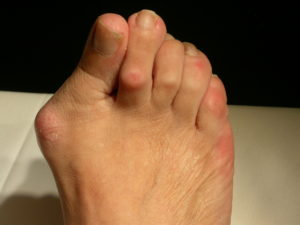
Bunions or hallux valgus tend to give pain predominantly from the metatarsal head on the inner border of the foot. The bunion is painful mainly when in enclosed in shoes and so is often more symptomatic in winter. The pain can persist even when shoes are removed and can be severe enough to prevent being able to wear enclosed shoes that press on the bunion at all.
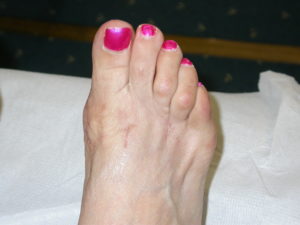
As the front part of the foot splays and the great toe moves across towards the 2nd toe a bunion can also produce pain from the 2nd toe itself. This can either be due to direct rubbing between the hallux and the 2nd toe, or the development of a hammer toe deformity (as shown in the picture above).The hammer toe will either be painful from its top aspect where it rubs directly on shoe wear or its under surface in the area of the 2nd metatarsal head. This is made prominent and pushed to the sole of the foot by the 2nd toe rising upwards and driving the metatarsal head downwards.
It is unusual to have much bunion or hallux valgus pain when out of shoe wear or at rest. There are exceptions to this and in particular if symptoms have been ignored during the day and the bunion has become very painful then some symptoms may be present at night. The pain from the region of the great or big toe at rest or at night is however more often a symptom of an arthritic big toe (hallux rigidus) rather than a straightforward bunion. To confuse matters these two conditions can sometimes coexist.
In summary, bunion or hallux valgus pain is most often present when walking in enclosed shoes. There may be little bunion pain in sandals or barefoot. It is unusual to have much bunion pain when not putting weight on the foot or at night. If there is bunion pain at rest or at night then there may also be arthritic change within the toe.
The causes of bunions are multifactorial and there is no single cause. There are factors which are recognised as being associated with their development .These are that they are more common in shoe-wearing populations , more common in females(by a long way) and more common in peoples who have a family history of the disorder.
The most appropriate thing to say about the natural history of bunions is that they are unpredictable. This is both in terms of whether the bunion deformity will progress, and also whether the bunion will become painful. It would probably however be true to say that once a previously pain-free bunion has started to become painful it is not common for the bunion to go back to being comfortable again.
There is no real advantage in considering early treatment of a bunion before it’s giving problems as whether it ever does is unpredictable. Though the exact nature of the surgery required may be slightly different if the degree of deformity subsequently progresses the chance of a successful outcome and type of recovery is little different.
In most people the first line of management is seeking out softer & wider shoes. When this is no longer effective (or if this is not appropriate ,for example for those who professionally require to wear narrower & more formal shoes) then it is worth considering surgical treatment.
Some people find the appearance of their feet highly embarrassing to the extent that it hinders aspects of their lives. Examples are not being willing to take children to a swimming pool or take a beach holliday. Pain is not necessarily a prerequisite for surgical treatment ,but having a problem is.
The choice of treatment for a bunion lies between non-operative (conservative) and operative treatment. Conservative treatment for a bunion means either wearing wider fitting shoes or shoes with softer leather or using some form of a spacer between the big toe and 2nd toe (or alternatively some form of splint to keep the great toe away from the 2nd toe). The spacers or splint may apparently straighten the bunion but they make no difference to the width of the foot due to the splaying of the 1st and 2nd metatarsals which occur with a bunion deformity. Therefore this type of treatment will not improve the main pain in a bunion which occurs due to the width of the forefoot. An arch type support orthotic may also be useful if a bunion is associated with a flatter foot. If you have a bunion this is however just one other thing to get into a shoe with an already wide foot.
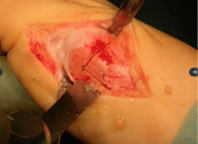
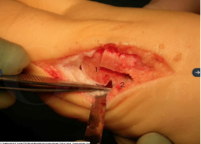
There are hundreds of different operations described for the treatment of Hallux Valgus. Whatever their precise nature they have two key components. The first is the repositioning of the 1st metatarsal back closer to the 2nd metatarsal, by means of cutting some of the metatarsal and displacing it (a procedure known as an osteotomy). The second is the rebalancing of the soft tissues around the joint.
The type of operation chosen by your surgeon is likely to be determined by the magnitude of the Bunion deformity. This is classified into mild ,moderate or severe primarily according to the extent of the splaying between the 1st and second metatarsals.
For a mild deformity a small amount of displacement to the metatarsal is required and this is most often performed using a Chevron osteotomy as shown in the picture above.
More common is a moderate deformity and this requires more of the 1st metatarsal to be moved which is most commonly done with an operation known as a Scarf osteotomy , before and after X-rays of which from a clinic patient are shown below.
For severe bunion deformities an operation know as a basal osteotomy is most often required and photographs of a clinic patient having undergone one of these operations are shown below.

Surgery is performed as a day-case or overnight stay. Surgery is under a GA and a popliteal nerve block is used for post-operative pain relief. Weight bearing using a post-operative shoe is possible once the block has worn off.
LMW Heparin is required for 2 weeks post-operatively to reduce the chance of DVT.
Weight bearing is using appropriately stiff post operative shoe for 4-6 weeks
Crutches are likely required 1-2 weeks
Patient are taught self-mobilisation of the MTP from 1 week post op, both active and passive. A thera-band is useful for this .The key is achieving dorsi-flexion early. My routine is to suggest 20 -30 cycles of plantar/dorsi-flexion using & against the thera-band three times per day. Physio supervision from 4 weeks if patients haven’t achieved an adequate range.
Kellers bandage/post operative splint for 4-6 weeks post-operatively. How this is applied is critical. Any tendency to over or under correction at the MTP level occurring in this immediate post-operative period should be actively managed by corrective splint age.
Dressings to continue 24/7 until all wounds are dry.
From 4 weeks the patients should cleanse the foot twice a day, once in a salt water bath and once by bathing/showering
Dressings ,especially to medial wounds , to continue for the first month in normal shoe-wear to avoid rubbing of the scar which can predispose to developing a mild cellulitic infection.
Appropriate shoe-wear fit is vital in the first month or so after the post-op shoe
I advise fit-flops , Uggs , wider fits or open sandals. Stiffer heels ( platform or wedge ) are encouraged in women , from when comfortable , to promote MTP dorsi-flexion.
Patients may static bike & swim from 4-6 weeks(once out of bandaging) , cross-train from 6-8 weeks and re-start light jogging on treadmill from 9 weeks at soonest .
Forefoot swelling is normal for 4 months approximately post-op.
Irrespective of the exact technique used (including minimally invasive techniques) the foot undergoes the same changes post-operatively and the same tissues (bone & soft tissue) need to repair themselves. The timescale on this is largely determined by species & genus & not the exact nature of the operative technique.
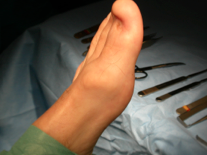
There are a couple of common forefoot conditions (both of which can co-exist with Hallux Valgus) which can be confused with the condition. The first is Hallux Rigidus (or Big toe arthritis) where the prominence sits on the top of the foot not the side as shown above in this photograph.
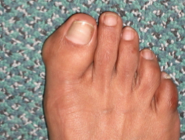
The other is Hallux Interphalangeus where the deformity lies at the joint further towards the tip of the big toe (the interphalangeal joint). This is non-progressive and often effects both big toes and also often minimally symptomatic .A picture of quite a severe deformity is seen below .

I chose to visit the Foot and Ankle Clinic as a self-funding patient after extensive research into foot services available to me both on the NHS and privately. I wanted to choose my surgeon and in particular feel confident that they were experienced, recommended by their fellow professionals, medically qualified and had the full range of operative treatments available to them.
My outpatient appointment was punctual and I did not feel hurried. I was examined and felt that I had time to ask any questions that I needed to. I was given unambiguous advice and full explanations as to why a particular operation was right for me. Risks and possible complications were discussed with me. This information was confirmed in writing, which I found helpful.
I emailed the secretary with a question preoperatively and had a prompt reply. My admission was uncomplicated and I saw both my surgeon and anaesthetist pre-operatively. My post-op stay in hospital was comfortable with excellent care from the nursing and physiotherapy staff.
Following discharge I was in discomfort requiring painkillers for about five days. I got up and about quickly and had no post-operative problems.
My two follow up appointments were both punctual and unhurried, I felt able to ask any further questions. I was particularly happy that I was followed up by the surgeon himself at two weeks and redressed them placing my toes in the correct position.
I am now three and a half months post-op and very happy with my rehabilitation so far. My toes are all aligned in the correct plane and movement is returning unlike other people I have seen at this stage. I feel that the attention to detail at operation and post-op has ensured this.
I am happy to recommend The Foot and Ankle Clinic.
Dr. E Stokes
Birmingham
I am delighted to write about my experiences at The Foot and Ankle Clinic.
All The Health Care Professionals at The Foot and Ankle Clinic attended to me with Care and respect at all times.
I felt fully informed about surgery and the aftercare before I decided to go ahead with my operation. I found the website with visual examples of surgical procedures, and postoperative information, enabled me to make informed choices after my consultation
A letter confirmed test results following a consultation, and what was to happen next. This was very reassuring as often patients forget some of the details on returning home.
Appointments were easy to arrange and convenient, both in Edgbaston and Sutton Coldfield.
My experience was that I had no postoperative pain as it was controlled during the operation. This gave me an east transition form hospital to home and recovery.
The postoperative shoe is wonderful! It gave me full mobility within days of the operation, which I am sure, helped me recover more quickly.
Exercises to regain full mobility were simple to follow and easy to do-they really worked.
Mrs V Swinnerton
Birmingham
I would be delighted to write a few lines on the experience I had at the Foot and Ankle Clinic in relation to my recent surgery. You will be pleased to know that I am now back in my high heels and am adding to my collection of shoes at a rate that even Imelda Marcos would be proud of.
After much deliberation and trepidation I arrived at the Foot and Ankle Clinic to undergo surgery on my painful bunion that was at a stage where it was making everyday life very uncomfortable and painful. Prior to this I had attended the Clinic for a lengthy and extremely informative consultation I felt confident that the treatment offered was for me. The surgeon informed me of exactly what the operation entailed the down time and most importantly for me of pain to be expected. The whole hospital experience from being registered to leaving was excellent. My stay was one night only and pain experienced was surprisingly minimal expelling the myth that this is a very painful operation. I was mobile within hours with the aid of a specially designed shoe and needed painkillers for the first couple of days only. After this time I did not need painkillers at all. I visited for a post-operative consultation after two weeks to have the bandages removed and the wounds checked and redressed. Immediately I was very impressed with the results. After a further three weeks the bandages were removed completely and I walked out of the Clinic in normal everyday shoes, albeit of a flatter slightly wider fitting nature than previously. After three months there was only minor swelling and after 6 months the foot was completely healed.
Driving was possible after 5 to 6 weeks. The whole experience was such that I regretted only having the one bunion operated on and so I immediately booked another consultation and had the other foot done a year later. I no longer suffer from painful aching feet at the end of the day and the results are nothing short of amazing. I only wish I had visited the Clinic years ago.
Mrs S France
Worcestershire
I am a retired teacher and have had bunions on both feet for a number of years. Within the last two years, prior to the operation, they became increasingly painful and started deforming the toes. The toes started to overlap each other due to the pushing pressure of the big toe and bunion. In addition I had great difficulty wearing shoes of any kind. It became a nightmare to buy new shoes due to the deformity.
On consulting the Foot and Ankle Clinic I was delighted with the surgeons diagnosis and recommendation to remove both bunions at the same time. This was precisely what I wanted to hear, as I did not relish having one operation, only to return several months later for a second operation.
Whilst in the Priory I only needed an overnight stay in and was able to get up and walk the following morning without pain with the aid of crutches. Within one week I did not need the crutches and was able to walk properly again painfree. I had to wear special sandals whilst recuperating. These were provided by the hospital and were very helpful and comfortable.
I felt the operation had been a total success and the aftercare was extremely reassuring and considerate. Needless to say I am now back to my fully active life which comprises of dance, keep fit, and yoga classes. Furthermore I am tickled pink with my glamorous new feet and shoes.
Mrs B Lupasco
Birmingham
I had been suffering with a bunion for some time which had gradually become more painful and which was making it difficult to wear any shoes apart from wide trainers. This was obviously not very attractive or appropriate for work!
I visited the Foot and Ankle Clinic with a certain amount of trepidation having heard scare stories about bunion operations. The consultation was very reassuring and informative and I was struck by nothing but professionalism.
After a slick and painfree bunion operation, I had a comfortable overnight stay at the Priory and returned home bunion free. After a few weeks healing I was as good as new and now, a year later, I feel it was one of the best decisions I have ever taken. I now have a perfect foot and am able to wear any shoe I like!
Mrs Ellis
Leicestershire
I would just like to say a big thankyou to everyone at the Foot and Ankle Clinic for this assistance with my foot in November 2010. I am walking pain free and also cosmetically delighted with my bunion correction result. Thank you.
M Harrison
Worcestershire
I’d had bunions since the age of 11 when I was told by the school nurse that they may or may not get any worse!! Of course, over the years they did get worse and I got to the stage where I would hide my feet in any way I could and shopping for shoes was a nightmare! They were also becoming quite painful and would throb if I overdid the walking that I so enjoyed. I’d been told many times how painful it was to have them operated on and so had held off doing anything about it until last year. I spoke to one or two people who’d been through surgery and they had given me inspiration and hope.
I attended the Foot and Ankle Clinic Ltd in Autumn 2011. The surgeon instantly put me at ease and advised me to have both feet done at the same time. I chose the winter as I felt it would be easier to be incapacitated during the cold weather and I could virtually hibernate for 6 weeks!!!
So, at the ripe old age of 58 I took the plunge. Am I happy now…..you bet!! It was nowhere as bad as I’d thought it would be…..virtually painless, just slightly uncomfortable and inconvenient at times.
My recovery was amazing and the result is that I am now proud to show off my feet to anyone, anytime, any place. I can wear all those pretty little sandals I’ve always dreamed of doing and still can’t believe these feet belong to me.
Thank you to the surgeon and the Clinic staff for changing my life….a cliche, I know, but so true.
Mrs. J Lucas
Birmingham
Having suffered from unsightly bunions on both feet for decades, I finally sought the advice of The Foot and Ankle Clinic when I also developed severe pain in the ligaments in my right foot. This was diagnosed as a Mortons Neuroma. In addressing this complaint, I took the opportunity whilst undergoing surgery to have the bunions removed from both feet simultaneously. My first surprise was how little post operative pain I encountered. Now, one year later, I have no further pain from the Mortons Neuroma and wonder why I did not have my disfiguring bunions removed years ago.
A Forrest
Sutton Coldfield
West Midlands
Over the past couple of years my bunion had been getting more painful and was causing my big toe to crossover my adjacent toe. Getting shoes to fit let alone be comfortable was becoming increasingly more difficult, especially sandals in the summer.
I contacted the Foot and Ankle Clinic and made an appointment to discuss a possible resolution to my problem. The surgeon took time to explain what the procedure would entail and also stressed that swelling could last for several months. I was even able to go onto the internet and look at a short video of the procedure. What I will also say is that there was never any pressure from the Surgeon only information. He then left it up to me to get back in touch with him if I wanted to go ahead with the operation.
I was able to choose the date that best suited me for the operation. After the procedure I had an overnight stay in hospital and was home the next day with all the medication required to make the next few days as comfortable as possible.
After 2 weeks I was followed up at the Priory where my wound was redressed and I was amazed at how normal it look from the last time I had seen it. I was very pleased with the results and all the care and aftercare I received at the Clinic.
D Whyte
Birmingham
For a number of years I had suffered problems with my left foot in spite of wearing a number of different orthopaedic devices. The discomfort was approaching a level where walking, which I enjoy, was becoming very difficult and painful and I was becoming increasingly concerned about my mobility.
As a consequence my GP referred me to The Foot and Ankle Clinic in May 2008 and following a thorough examination and x-rays an operation involving forefoot reconstruction was carried out successfully in June 2008.
Following a short period of convalescence, including several follow-up appointments to check the healing process, I was able to resume normal walking without any discomfort, and continue to do so much to my relief and well being.
Mrs B Tyler
West Midlands